Guide
Hire a salesperson or outsource sales in the Baltics.
What each option costs in Lithuania, Latvia, Estonia and Finland, how long each takes to start, and the cases where hiring is clearly the right answer.
The short answer: if you do not yet know whether the region will buy, outsource first and hire once there is revenue to hire against. If the region already produces enough revenue to pay a full salary comfortably, hire, and hire in Lithuania, where the employer add on is 1.77 % of gross pay.
The comparison, in one table.
| Salesperson or country manager, employed | Outsourced sales team | |
|---|---|---|
| What you pay | Salary plus employer social charges, plus car, tools, travel and management time | A monthly fee, usually with a fee per qualified meeting or a commission on closed deals |
| Cost if nothing sells | The full amount, every month | The monthly fee |
| Local entity needed | Yes, or an employer of record | No |
| Time to start | Three to six months to recruit | Two to four weeks |
| Time to know whether it worked | Nine to eighteen months | Two quarters |
| Languages covered | Usually one or two | Several, if the team has native speakers |
| Attention you get | All of it | A share of it, alongside other clients |
| Exit cost | Notice, severance, possibly the entity | The notice period in the contract |
| Who owns the customers | You | You, if the contract says so. Check that it does |
The cost side, with real numbers.
Lithuania’s statutory minimum monthly wage in 2026 is €1,153 gross, and the national average was €2,628.20 gross in the second quarter of 2026. A senior B2B salesperson sits well above the average. Public salary surveys for that specific role are thin, so any single figure quoted to you is probably a guess.
What is solid is the employer add on. In Lithuania the employer pays 1.77 % on a standard open ended contract, so total employer cost is close to gross salary. In Germany the employer share in 2026 is 19.55 %, so a salesperson on €3,000 gross costs about €3,590 a month before anything else.
Then add the parts nobody models. The entity or employer of record, recruitment, a car, equipment, and the time of whoever at head office now manages someone in another country. Add the failure rate too, because a first hire into a small and unfamiliar market does not always work out.
What an employer pays on top of gross salary, in each country.
The number that decides whether hiring is affordable is not the salary. It is the employer’s social charge on top of it, and the four countries are nothing like each other.
| Country | Employer add on | Cost of €3,000 gross | Note |
|---|---|---|---|
| Lithuania | 1.77 % | €3,053 | Open ended contract, accident risk group I. A fixed term contract in the same group is 2.49 % |
| Finland | around 20 % | about €3,600 | Varies with the pension insurer and the size of the payroll |
| Latvia | 23.59 % | €3,708 | Employer share of a 34.09 % total. Contributions are capped at €105,300 of annual income, above which a solidarity tax applies |
| Estonia | 33.8 % | €4,014 | 33 % social tax plus 0.8 % employer unemployment insurance. No ceiling, and a monthly floor of €292.38 in social tax whatever the salary |
| Germany, for comparison | 19.55 % | about €3,590 | Employer share of social insurance, 2026 |
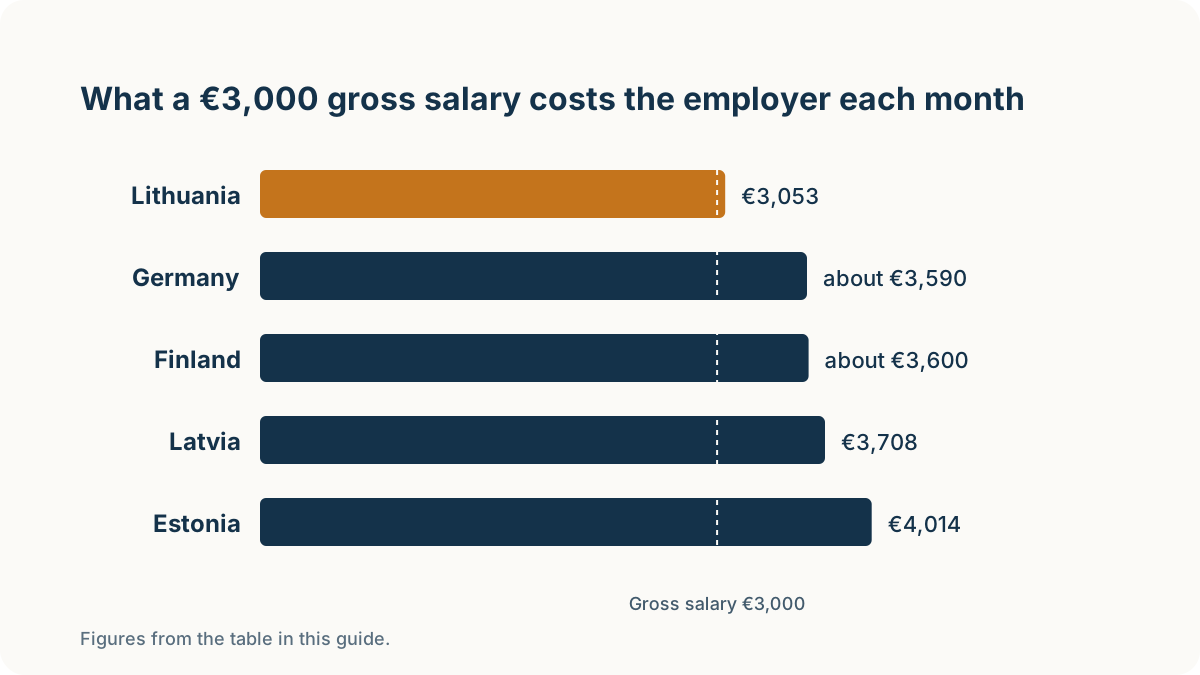
Lithuania looks cheap because the burden sits on the employee, not the employer. Lithuanian employees pay 19.5 % to Sodra and 20 to 32 % income tax out of the same gross figure. A Lithuanian salesperson therefore costs an employer very little on top of salary, and takes home noticeably less of it than a German one would.
The practical consequence is simple. If you are going to employ someone in this region, employ them in Lithuania. If you are not yet sure the region works at all, the comparison that matters is between an employee and an outsourced team.
The tax question.
Employing someone in Lithuania requires a local entity or an employer of record, and the entity has its own tax profile. An outsourced sales team working from its own office, for several clients, and not signing contracts in your name, does not normally create a taxable presence for you. If an outside party habitually concludes contracts in your name, that can change. Keep the signature at head office, and take advice from your own tax adviser on your facts.
When to hire instead.
- The region already produces enough revenue to pay a full salary comfortably.
- The role is more than selling, and includes local operations, service, a warehouse or a team.
- You need someone inside your systems, your meetings and your culture full time.
- You bid for public tenders that require a local entity anyway.
- The product needs so much technical depth that no outside team could carry it credibly.
When to outsource instead.
- You do not yet know whether the market is real.
- The region is four small countries rather than one large one, and no single employee covers all four languages.
- You want the cost tied to meetings and deals rather than to headcount.
- You want to be selling in two months, not next year.
If you want to test Lithuania, Latvia, Estonia or Finland before hiring your own salesperson, see how our Pipeline service works and what it costs.
The sequence that usually works.
Outsource first and hire later. Use the outsourced team to find out whether the market supports a full time person, and then hire against real revenue rather than a forecast. Agree at the start what happens to the pipeline and the customer data when you hire, so the handover is simple.
get2market is an outsourced sales team, so read this guide knowing that. The figures are sourced below and hold whoever you work with.
Sources
Every figure on this page comes from one of these, read on the date shown.
- Sodra, contribution rates, 1.77 per cent employer social insurance in Lithuania
- State Data Agency, average monthly earnings, €2,628.20 gross, Q2 2026
- Estonian Tax and Customs Board, the 33 per cent social tax
- Lohn-Info, German employer contributions 2026, the 19.55 per cent employer share
- Eurostat, minimum wages and earnings, the 2026 comparison across member states
- OECD Model Tax Convention, Article 5, when an outside party creates a permanent establishment
Read 20 to 22 September 2026.
Last reviewed 2026-09-23. Next review 2027-03-23. Written by get2market, Vilnius. Figures are dated where they are quoted.
FAQ
Frequently asked
Is outsourcing sales cheaper than hiring a country manager in the Baltics?
Cheaper while nothing is selling, and not necessarily cheaper once a lot is. An outsourced team costs a monthly fee plus fees tied to meetings or deals. An employee costs the same every month whatever happens. At high revenue a salaried person can be cheaper, which is why the usual sequence is outsource first and hire later.
What does an employee cost an employer in Lithuania?
Gross salary plus 1.77 per cent employer social insurance on a standard open ended contract in accident risk group I. A salesperson on €3,000 gross costs about €3,053. The same salary costs about €3,708 in Latvia, €4,014 in Estonia and about €3,600 in Finland.
Do I need a company in Lithuania to hire someone there?
Yes, a local entity or an employer of record. An outsourced sales team needs neither, because it invoices you from its own company.
How fast can each option start?
An outsourced team can start in two to four weeks. Hiring a country manager takes three to six months to recruit and another six to twelve before you can judge the result.
Discuss your target market.
Tell us what you sell, who buys it and which country you want to enter. We will discuss which service fits and what we would do first.
You receive a written proposal within three working days of the call. For Pipeline, the first target list follows two weeks after signing.